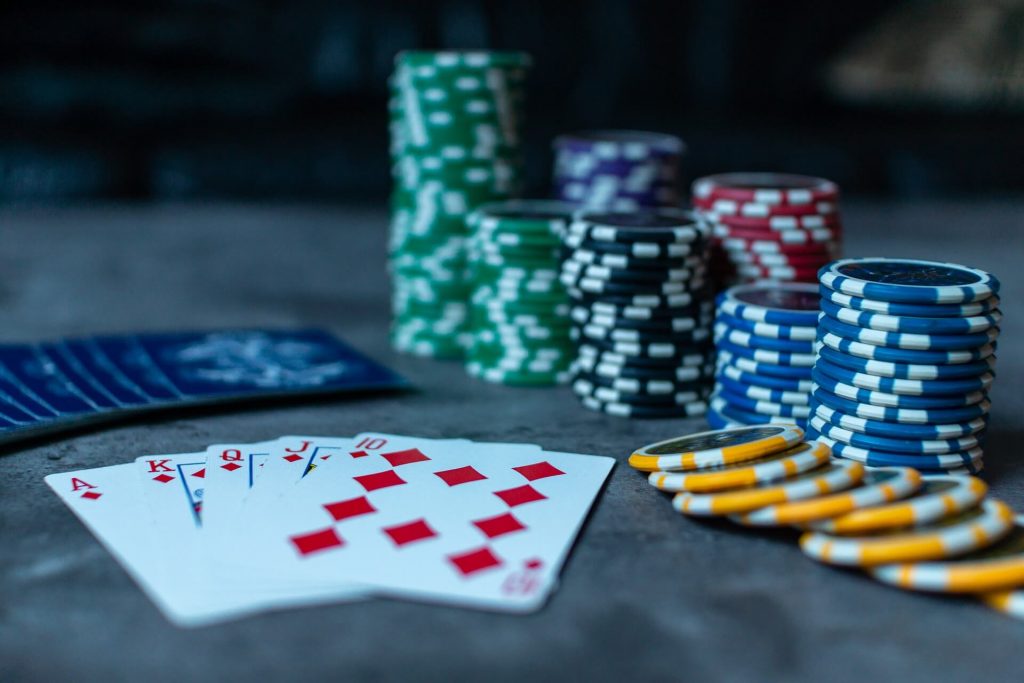
Anyone who likes to play the game of poker will eventually make their way over to a casino in the hopes of winning some money at a hand or two. Casinos actually house a couple of very different styles of poker. The first kind is likely the poker variation you were expecting to play when you came to the casino; you against some other players, a professional dealer in the middle, and you’re trying to take the pot with the best hand. The other version, casino poker, is a little bit different.

The two types of poker are usually split into two different areas of the casino. Bigger casinos have poker rooms for players looking to playing against other players. The casino makes their profit off of the game by taking a percentage of the pots as their rake. The casino poker games that you can find in the regular casino room, on the other hand, are not played against other players. Instead, they are played against the house. If the house has a better hand than you do, you lose your ante and your bet, and it all goes to the casino. This is very similar to your odds when playing games like slots and bingo available at www.littlewoodsbingo.com.

The biggest difference between casino poker and regular poker is that casino poker games have a house edge; a player does not stand to gain money in the long term. Think about it this way; when you are playing against other players, odds and luck as well as skill will all come into play; you can bluff and read their bluffs, and players familiar with the game have a good chance of winning money in the long run. The rules in casino poker games, on the other hand, mean that you are unlikely to win match after match at the hall. Even skilled poker players will lose money to the casino in the long run, because the payouts do not match the odds.

Casino poker is still popular with those who enjoy games of chance, so we will take a quick look at some of the most common versions of poker that can be found in casinos.

 Caribbean Stud Poker. This is a version of five card stud. Casinos will pay out not only for a hand that beats the dealer’s, but also odds on the hand that a player has. The rarer the hand, the higher the payout.
 Chinese poker. This form of poker is getting more popular as it takes a bit of concentration and a lot of luck to win. And luck of course is where the casinos make their money; payouts are lower than odds.
 Pai Gow poker. The same as the game pai gow, but played with cards instead of dice. Two hands are created out of seven cards, and both must beat the dealer.

If you like casino games and poker, then playing poker in a hall might not be such a bad idea. Remember, though, that playing casino poker games isn’t the same as playing regular poker games; you’re playing the house against the odds, and won’t rack up a good bankroll in the long run.

This was the primary poker game played in California during the heyday of Gardena in the 1970s. It is still played today, though its popularity has somewhat lessened since the introduction of stud poker and community card poker to the state.

Played as above, using ace-to-five low hand values, with a single joker in the deck. Always played with blinds rather than antes, so players may not check on the first betting round (but may on the second round). A player with a 7-high hand or better who checks after the draw forfeits his right to win any money placed in the pot after the draw. (In other words, you may not check a “seven” unless you intend to fold when someone else bets). Another common rule in low-limit games is that a player who checks on the second betting round may not subsequently raise on that round. This latter rule is never used in games with a pot limit or no limit betting structure.

Copyright (C) 2000,2001,2002  Free Software Foundation, Inc.
51 Franklin St, Fifth Floor, Boston, MA  02110-1301  USA
Everyone is permitted to copy and distribute verbatim copies
of this license document, but changing it is not allowed.


Seven-card stud is a variant of stud poker. Until the recent increase in popularity of Texas hold ‘em, seven-card stud was the most popular poker variant in home games across the United States, and in casinos in the eastern part of the country. Seven-card stud is also played in western American casinos, but Texas hold ‘em is far more popular there. Two to eight players can play.

The descriptions below assume that you are familiar with the general game play of poker, and with hand values. They also make no assumptions about what poker betting structure is used. In casino play, it is common to use a small ante and bring-in. In home games, it is typical to use an ante only.

Quick play overview
Play proceeds as follows (”player” refers only to those who have not folded and are still in the game), with betting rounds in-between.

Betting is clockwise, the player with the highest poker hand showing starts (ie 2-2 beats K-Q).

2 cards dealt face down to each player, 1 card dealt face up
upcard to each player
downcard to each player
showdown
Mnemonic: Two down, four up, one down.

In-depth play rules
The game begins with each player being dealt two cards face down and one card face up. If played with a bring-in, the player with the lowest-ranking upcard pays the bring-in, and betting proceeds after that in normal clockwise order. The bring-in is considered an open, so the next player in turn may not check. If two players have equally ranked low cards, suit may be used to break the tie and assign the bring-in (see high card by suit). If there is no bring-in, then the first betting round begins with the player showing the highest-ranking upcard, who may check. In this case, suit should not be used to break ties. If two players have the same high upcard, the one first in clockwise rotation from the dealer acts first.

After the first betting round, another upcard is dealt to each player (after a burn card, and starting at the dealer’s left as will all subsequent rounds), followed by a second betting round beginning with the player whose upcards make the best poker hand. Since fewer than five cards are face up, this means no straights, flushes, or full houses will count for this purpose. On this and all subsequent betting rounds, the player whose face-up cards make the best poker hand will act first, and may check or bet up to the game’s limit.

The second round is followed by a third upcard and betting round, a fourth upcard and betting round, and finally a downcard, a fifth betting round, and showdown if necessary. Seven-card stud can be summarized therefore as “two down, four up, one down”. Upon showdown, each player makes the best five-card poker hand he can out of the seven cards he was dealt.

You may note that seven cards to eight players plus four burn cards makes 60 cards, and there are only 52 in the deck. In most games this is not a problem because several players will have folded in early betting rounds. But there are certainly low-stakes home games where few if any players fold. If this is the case in your game, you may want to limit the game to seven players. If the deck does become exhausted during play, previously-dealt burn cards can be used when only a few cards are needed to complete the deal. If even those are not sufficient, then on the final round instead of dealing a downcard to each player, a single community card is dealt to the center of the table, and is shared by everyone (that is, each player treats it as his seventh card). Under no circumstances can any discarded card from a folded hand be “recycled” for later use. Unlike draw poker, where no cards are ever seen before showdown, stud poker players use the information they get from face-up cards to make strategic decisions, and so a player who sees a certain card folded is entitled to make decisions knowing that the card will never appear in another opponent’s hand.

Sample deal
The sample deal below assumes that a game is being played by four players: Alice, who is dealing in the examples; Bob, who is sitting to her left; Carol to his left; and David to Carol’s left.

All players ante $.25. Alice deals each player two downcards and one upcard, beginning with Bob and ending with herself. Bob is dealt the 4♠, Carol the K♦, David the 4♦, and Alice the 9♣. Because they are playing with a $1 bring-in, David is required to start the betting with a $1 bring-in (his 4♦ is lower than Bob’s 4♠ by suit). He had the option to open the betting for more, but he chose to bet only the required $1. The bring-in sets the current bet amount to $1, so Alice cannot check. She decides to call. Bob folds, indicating this by turning his upcard face down and discarding his cards. Carol raises to $3. David folds, and Alice calls.

Alice now deals a second face-up card to each remaining player: Carol is dealt the J♣, and Alice the K♥. Alice’s two upcards make a poker hand of no pair, K-9-high, and Carol has K-J-high, so it is Carol’s turn to bet. She checks, as does Alice, ending the betting round. Another face up card is dealt: Carol gets the T♥, (T = 10) and Alice gets the K♣. Alice now has a pair of kings showing, and Carol still has no pair, so Alice bets first. She bets $5, and Carol calls. On the next round, Carol receives the T♦, making her upcards K-J-T-T. Alice receives the 3♠. Alice’s upcards are 9-K-K-3; the pair of kings is still higher than Carol’s pair of tens, so she bets $5 and Carol calls. Each player now receives a downcard. It is still Alice’s turn to bet because the downcard did not change either hand. She checks, Carol bets $10, and Alice calls.

That closes the last betting round, and both players remain, so there is a showdown. Alice shows her cards: 9♥ 5♦ 9♣ K♥ K♣ 3♠ 5♠. The best five-card poker hand she can play is K-K-9-9-5, making two pair, kings and nines. Carol shows Q♠ 2♥ K♦ J♣ T♥ T♦ A♦. She can play A-K-Q-J-T, making an ace-high straight, and so Carol wins the pot.

Copyright (C) 2000,2001,2002  Free Software Foundation, Inc.
51 Franklin St, Fifth Floor, Boston, MA  02110-1301  USA
Everyone is permitted to copy and distribute verbatim copies
of this license document, but changing it is not allowed.

Five-card draw is often the first poker variant learned by most players, and is very common in home games although it is now rare in casino and tournament play. The lowball variations make more interesting games and are more commonly played in casinos. Two to eight players can play.

The descriptions below assume that you are familiar with the general game play of poker, and with hand values. They also make no assumptions about what betting structure is used. In casino play, it is common to use blinds; the first betting round thus begins with the player to the left of the big blind, and subsequent rounds begin with the player to the dealer’s left. In home games, it is typical to use an ante; the first betting round begins with the player to the dealer’s left, and the second round begins with the player who opened the first round.

Play begins with each player being dealt five cards, one at a time, all face down. The remaining deck stub is placed aside, often protected by placing a chip or other marker on it. Players pick up the cards and hold them in their hands, being careful to keep them concealed from the other players. The first “before the draw” betting round occurs at this point, starting with the player to the dealer’s left (or to the left of the big blind if blinds are used).

If more than one player remains after the first round, the “draw” phase begins. Each player specifies how many of his cards he wishes to replace, and discards that many from his hand. The deck stub is retrieved, and after a burn card is dealt, each player in turn beginning at the dealer’s left is dealt from the stub the same number of cards he discarded, so that each player again has five cards. It is important that each player discards the cards he wishes to replace before he takes any replacements, and that he take the same number of replacements as he discarded.

A second “after the draw” betting round occurs after the draw phase, beginning with the player to the dealers left or else beginning with the player who opened the first round (the latter is common when antes are used instead of blinds). This is followed by a showdown if more than one player remains, in which the player with the best hand wins the pot.

A common “house rule” in some places is that a player may not replace more than three cards, unless he draws four cards while keeping an ace (or wild card). This rule is only needed for low-stakes social games where many players will stay for the draw, and will help avoid depletion of the deck stub. In more serious games such as those played in casinos it is unnecessary and generally not used. A rule that is used by many casinos is that a player is not allowed to draw five consecutive cards from the deck stub. In this case, if a player wishes to replace all five of his cards, he is given four of them in turn, the other players are given their draws, and then the dealer returns to that player to give him his fifth replacement (if no later player drew, it is necessary to deal a burn card first).

Another common house rule is that the bottom card of the deck is never given as a replacement, to avoid the possibility of someone who might have seen it during the deal using that information. If the deck stub is depleted during the draw before all players have received their replacements, the last players can receive cards chosen randomly from among those discarded by previous players. For example, if the last player to draw wants three replacements but there are only two cards remaining in the deck stub, the dealer gives the player the one top card he can give, then shuffles together the bottom card of the deck, the burn card, and the earlier players’ discards (but not the player’s own discards!), and finally deals two more replacements to the last player.

Sample deal
The sample deal below assumes that a game is being played by four players: Alice, who is dealing in the examples; Bob, who is sitting to her left; Carol to his left; and David to Carol’s left.

All four players ante $.25. Alice deals five cards to each player and places the deck stub aside. Bob opens the betting round by betting $1. Carol folds, David calls, and Alice calls, closing the betting round. Bob now declares that he wishes to replace three of his cards, so he removes those three cards from his hand and discards them. Alice retrieves the deck stub, deals a burn card, then deals three cards directly to Bob, who puts them in his hand. David discards one card, and Alice deals one card to him from the deck stub. Alice now discards three of her own cards, and replaces them with three from the top of the deck stub (Note: in a player-dealt casino game there is often a rule that the dealer must discard before picking up the deck stub, but this is a home game so we won’t worry about such details). Now a second betting round begins. Bob checks, David bets $3, Alice calls, and Bob folds, ending the second betting round. David shows a flush, and Alice shows two pair, so David takes the pot.

Copyright (C) 2000,2001,2002  Free Software Foundation, Inc.
51 Franklin St, Fifth Floor, Boston, MA  02110-1301  USA
Everyone is permitted to copy and distribute verbatim copies
of this license document, but changing it is not allowed.

Draw poker is any poker variant in which each player is dealt a complete hand before the first betting round, and then develops the hand for later rounds by replacing cards.

The descriptions below assume that you are familiar with the general game play of poker, and with hand values (both high and low variations). They also make no assumptions about what betting structure is used. In home games, it is typical to use an ante, and betting always begins with the player to the dealer’s left. In casino play, it is more common to use blinds; the first betting round thus begins with the player to the left of the big blind, and subsequent rounds begin with the player to the dealer’s left, thus draw games are very positional.

Standard five-card draw
Five-card draw
This is often the first poker variant learned by most players, and is very common in home games although it is now quite rare in casino and tournament play. Two to eight players can play.

Other draw games

Gardena jackpots (”Jacks to open” or simply “Jackpots”)
Played as above, with standard hand values, and with a single joker in the deck acting as a bug. Always played with an ante and no blinds. On the first betting round, no player is allowed to open the betting unless his hand already contains a pair of jacks or a better hand. Other players who checked on the first round may subsequently call or raise if someone else opens. If no player opens, a new deal begins and everyone antes again into the same pot. The player who opened the betting keeps his discarded cards near him on the table so that he can prove, if necessary, that he had a sufficient opening hand. For example, a player with the K, J, 9, and 7 of clubs and the J of hearts has a pair of jacks and may open. He may wish to “break openers” in this case by discarding the jack of hearts in an attempt to make the club flush, so he keeps the discarded jack to prove that he was entitled to open.

The game is named after the city of Gardena, California, where this game was especially popular from the 1930s to 1970s (though it was always secondary to lowball). At that time, there were more public poker tables in that small city than in all the rest of the United States. Public poker rooms are still a big industry there, though Las Vegas, Atlantic City, and other locations now have many more poker rooms than they did at that time. Because “Jacks to open” was the primary form of high-hand draw poker played there, traditional draw poker was often described by the retronym “Guts to open”.

In home games, it is common that when a deal is “passed out” (that is, when no one opens), the players re-ante, and the qualifier to open is raised to a pair of queens. If that deal is passed out, the qualifier is raised to kings, and finally to aces. This is called “progressive” jackpots.

Copyright (C) 2000,2001,2002  Free Software Foundation, Inc.
51 Franklin St, Fifth Floor, Boston, MA  02110-1301  USA
Everyone is permitted to copy and distribute verbatim copies
of this license document, but changing it is not allowed.

Seven-card stud is a variant of stud poker. Until the recent increase in popularity of Texas hold ‘em, seven-card stud was the most popular poker variant in home games across the United States, and in casinos in the eastern part of the country. Seven-card stud is also played in western American casinos, but Texas hold ‘em is far more popular there. Two to eight players can play.

The descriptions below assume that you are familiar with the general game play of poker, and with hand values. They also make no assumptions about what poker betting structure is used. In casino play, it is common to use a small ante and bring-in. In home games, it is typical to use an ante only.

Quick play overview
Play proceeds as follows (”player” refers only to those who have not folded and are still in the game), with betting rounds in-between.

Betting is clockwise, the player with the highest poker hand showing starts (ie 2-2 beats K-Q).

2 cards dealt face down to each player, 1 card dealt face up
upcard to each player
downcard to each player
showdown
Mnemonic: Two down, four up, one down.
In-depth play rules
The game begins with each player being dealt two cards face down and one card face up. If played with a bring-in, the player with the lowest-ranking upcard pays the bring-in, and betting proceeds after that in normal clockwise order. The bring-in is considered an open, so the next player in turn may not check. If two players have equally ranked low cards, suit may be used to break the tie and assign the bring-in (see high card by suit). If there is no bring-in, then the first betting round begins with the player showing the highest-ranking upcard, who may check. In this case, suit should not be used to break ties. If two players have the same high upcard, the one first in clockwise rotation from the dealer acts first.

After the first betting round, another upcard is dealt to each player (after a burn card, and starting at the dealer’s left as will all subsequent rounds), followed by a second betting round beginning with the player whose upcards make the best poker hand. Since fewer than five cards are face up, this means no straights, flushes, or full houses will count for this purpose. On this and all subsequent betting rounds, the player whose face-up cards make the best poker hand will act first, and may check or bet up to the game’s limit.

The second round is followed by a third upcard and betting round, a fourth upcard and betting round, and finally a downcard, a fifth betting round, and showdown if necessary. Seven-card stud can be summarized therefore as “two down, four up, one down”. Upon showdown, each player makes the best five-card poker hand he can out of the seven cards he was dealt.

You may note that seven cards to eight players plus four burn cards makes 60 cards, and there are only 52 in the deck. In most games this is not a problem because several players will have folded in early betting rounds. But there are certainly low-stakes home games where few if any players fold. If this is the case in your game, you may want to limit the game to seven players. If the deck does become exhausted during play, previously-dealt burn cards can be used when only a few cards are needed to complete the deal. If even those are not sufficient, then on the final round instead of dealing a downcard to each player, a single community card is dealt to the center of the table, and is shared by everyone (that is, each player treats it as his seventh card). Under no circumstances can any discarded card from a folded hand be “recycled” for later use. Unlike draw poker, where no cards are ever seen before showdown, stud poker players use the information they get from face-up cards to make strategic decisions, and so a player who sees a certain card folded is entitled to make decisions knowing that the card will never appear in another opponent’s hand.
Copyright (C) 2000,2001,2002  Free Software Foundation, Inc.
51 Franklin St, Fifth Floor, Boston, MA  02110-1301  USA
Everyone is permitted to copy and distribute verbatim copies
of this license document, but changing it is not allowed.

Texas hold ‘em (also hold’em, holdem) is the most popular of the community card poker games. It is also the most popular poker variant played in most casinos in the United States. Its no-limit betting form is used in the main event of the World Series of Poker (WSOP), as seen on ESPN, and the World Poker Tour, seen on The Travel Channel, and is widely regarded as the premier poker game.

Although it can theoretically be played by up to 22 players (or 23 if burn cards are not used), it is generally played with between 2 and 10 people. It is one of the most positional of all poker variants, since the order of betting is fixed throughout all betting rounds. Hold ‘em is commonly played outside of the United States, but seven-card stud, Omaha hold ‘em and other games may be more popular in some places.

Origins
There is no precise information on where or when Texas hold ‘em Poker was first played. According to legend, the earliest game played was in Robstown, Texas, in the early 1900s and it first came to Dallas, Texas in 1925. Texas hold ‘em was introduced to Las Vegas by a group of Texan gamblers and card players, including Crandell Addington, Doyle Brunson, and Amarillo Slim. [1] The game was later introduced to Europe by bookmakers Terry Rogers and Liam “The Gentleman” Flood.[2]

Rules
The descriptions below assume a familiarity with the general game play of poker, and with poker hands. For a general introduction to these topics, see Poker, Poker hand, Poker probability, and Poker jargon.

Objective
Like most variants of poker, the objective of Texas hold ‘em is to win pots, where a pot is the sum of the money bet by oneself and other players in a hand. A pot is won either at the showdown by forming the best five card poker hand out of the seven cards available, or by betting to cause other players to fold and abandon their claim to the pot.

Copyright (C) 2000,2001,2002
Free Software Foundation,
Inc. 51 Franklin St, Fifth Floor,
Boston, MA  02110-1301  USA
Everyone is permitted to copy and distribute verbatim copies of this
license document, but changing it is not allowed.